As DTC (Direct-to-Consumer) brands scale, one question always arises: How can marketing be managed efficiently? From startup founders juggling ads and content to established e-commerce organizations ready to expand, every brand eventually faces the same decision: whether to hire in-house, outsource e-commerce marketing, or blend both to handle performance, content, and brand growth.
Every model has its pros and cons when it comes to speed, cost, control, and measurability. The right choice for your brand’s stage and budget can determine whether growth continues or slows down.
Let’s unpack the key marketing support models for DTC brands and see how they compare.
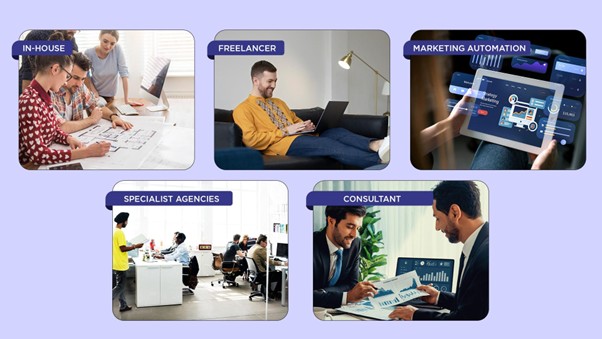
Overview of Key Options
In-House Teams
Building an in-house team gives you maximum control and alignment. Your team understands the brand inside out, builds deep knowledge over time, and can adapt quickly. For DTC brands focused on long-term storytelling, brand loyalty, and creative consistency, this can be a powerful approach.
However, the trade-off lies in cost and scalability. Hiring full-time marketers means paying fixed salaries, benefits, and software subscriptions, even during slower months. Add recruitment, onboarding, and training, and the total expense can quickly exceed what you’d spend with a specialist e-commerce agency. Plus, a single performance marketer might cost as much as a small agency team without the same cross-channel expertise.
Best-fit scenario:
- Established brands with steady revenue streams
- Those requiring daily collaboration between marketing, product, and customer support
Typical risks:
- High fixed costs
- Slower adoption of new tools and trends
- Potential creative stagnation if the team works in isolation
Freelancers & Contractors
Shifting from internal teams, another approach is to hire freelancers. Freelancers offer flexibility and cost efficiency, allowing brands to bring in experts for specific needs such as ad creatives, SEO, email flows, or influencer partnerships without long-term commitments.
The downside? Coordination. Managing multiple freelancers means juggling timelines, communication gaps, and quality control. Without a central strategy, campaigns can feel fragmented.
Best-fit scenario:
- Small DTC brands testing new markets or channels
- Founders comfortable managing multiple contributors
Pros:
- Budget-friendly
- Specialized expertise for niche tasks
Cons:
- Inconsistent output and reporting
- Limited accountability and bandwidth for scale
Consultants & Fractional CMOs
Consultants or fractional CMOs bridge strategy and execution. They work well when you need help defining customer journeys, setting performance KPIs, and building go-to-market plans before moving into full execution.
They often work with your internal or external teams to build playbooks and improve marketing ROI.
Best-fit scenario:
- Growth-stage DTC brands preparing for scale
- Companies needing expert leadership without full-time cost
Risks:
- High hourly rates
- Execution still needs to be handled by another team (in-house or outsourced)
Automation Platforms
AI and marketing automation have redefined what small teams can achieve. Tools like Klaviyo, Meta Advantage+, and Google Performance Max allow brands to automate campaigns, reporting, and segmentation.
For DTC marketers, this means faster testing cycles and less dependency on human bandwidth. But automation is not a silver bullet. Without strong creative and strategy inputs, even the smartest tools can underperform.
Best-fit scenario:
- Lean teams optimizing existing funnels
- Brands with consistent traffic and repeat purchase data
Limitations:
- Requires constant optimization
- Doesn’t replace creative or strategic thinking
Specialist DTC Marketing Agencies
A specialist e-commerce agency is built around the DTC ecosystem, handling everything from store experience and conversion strategy to retention and performance ads.
They bring end-to-end expertise in strategy, creative, paid media, and analytics in one integrated team.
Best-fit scenario:
- Scaling brands looking for consistent, measurable growth
- Founders who want expert execution without hiring full-time staff
Benefits:
- Faster execution with proven playbooks
- Access to cross-disciplinary expertise
- Easier cost control versus hiring multiple roles
Choosing between in-house vs agency vs freelancer marketing depends on three big levers:
Speed: Agencies and freelancers deliver faster because they already have tools and teams in place. In-house builds take longer but offer deeper brand immersion.
Cost: Freelancers seem cheaper at first, but managing multiple people and timelines can raise expenses. Agencies charge a set monthly fee, which is easier to predict but usually higher than hiring freelancers. In-house teams cost the most over time because of salaries, tools, and overhead.
Control & Measurability: In-house gives full control; agencies bring structure and KPIs; freelancers often lack unified reporting.
If growth, scalability, and clear metrics are your priorities, a specialist DTC marketing agency offers the best balance.
Where Tech Bay Leaf Fits & Why It Stands Out
At Tech Bay Leaf, we’re not just another agency. We’re a specialist e-commerce partner built for DTC growth.
Here’s how we help brands outperform traditional models:
- Full-funnel integration: Strategy, creative, and execution are aligned under one roof from Meta ads to Klaviyo flows to CRO.
- Offshore advantage: Our global delivery model ensures premium quality at competitive rates, offering a clear cost edge over local agencies.
- E-commerce specialization: Every strategist, designer, and analyst understands the DTC buyer journey from first click to repeat purchase.
- Proven impact: Clients consistently report 2–3x ROAS improvement and 30–40% faster turnaround across creative and campaign cycles.
We act as your extended growth team by combining the speed of an agency, the accountability of an in-house team, and the flexibility of automation.
Decision Criteria: Which Model Works for Your Brand
You may need an in-house team if:
- Your brand requires constant creative output and content testing
- You’ve hit a stable revenue ceiling and need daily coordination between teams
Freelancers might suffice if:
- You’re early-stage and testing traction
- You have internal marketing oversight but need hands for execution
A specialist agency is the right move when:
- You need integrated strategy and performance execution
- You want measurable growth without fixed hiring costs
- You’re expanding to new markets or channels and need scalable expertise
How to Get Started with Tech Bay Leaf
Working with Tech Bay Leaf is simple:
- Discovery & Audit: We assess your store, campaigns, and funnel performance.
- Strategy Sprint: We define growth priorities and channel mix.
- Execution & Optimization: Our team deploys, measures, and refines every campaign for ROI.
- Scale & Support: We provide monthly reviews, creative refreshes, and data-driven scaling.
Ready to see how a specialist DTC marketing agency can accelerate your growth?
Choosing What Works for You
The best marketing model for your e-commerce brand isn’t one-size-fits-all. Each approach brings distinct strengths.
The key is to match your brand’s stage, resources, and growth goals to the right model.
For many scaling DTC brands, partnering with a specialist e-commerce agency like Tech Bay Leaf delivers the perfect mix of strategy, speed, and cost efficiency helping you grow smarter and faster.