A new era of search results has arrived—and it’s challenging how we capture web traffic. Google’s AI Overviews, part of the Google Search Generative Experience (SGE), dominate the top of search results, offering users instant answers and reducing the need to click through to websites. As a result, organic traffic and click-through rates are dropping fast.
In this article, we explore the impact of AI Overviews, why clicks are disappearing, and how marketers can adapt to Google’s AI Overviews with practical SEO strategies to regain lost traffic from AI Overviews in 2025 and beyond.
What Are Google AI Overviews (and Why SEOs Are Worried)
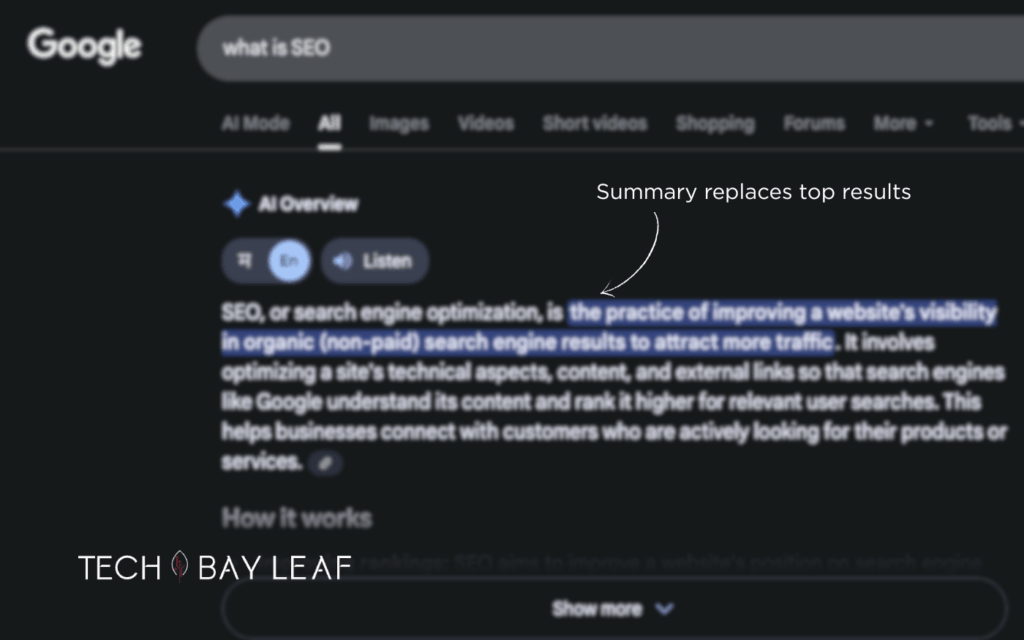
Google AI Overviews are essentially summary boxes generated by AI that appear above organic listings. They pull insights from multiple sources and present them in a concise, easy-to-read format. They show up before the top search result, providing instant answers to queries.
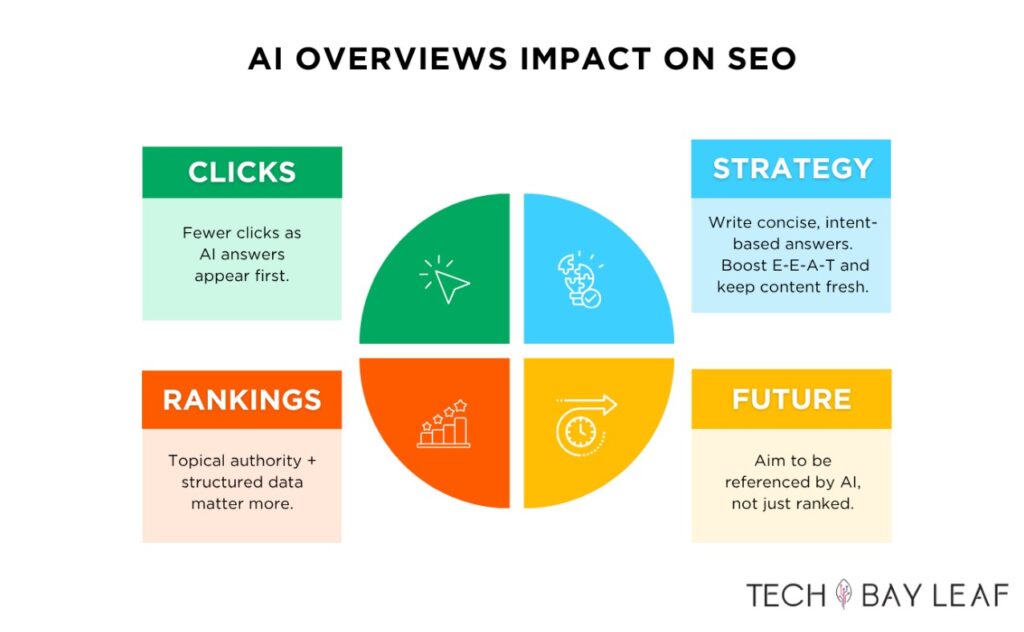
For SEO, the rules are now against it. Traditional search engine optimization relied on ranking high in organic results to generate clicks, but AI Overviews reduce the need for users to leave Google’s interface. Studies show that pages previously receiving high traffic for informational queries now see significantly lower CTR, with a corresponding rise in zero-click searches in 2025. Even well-established content can be summarized into an AI snippet, leaving users satisfied without visiting the source site.
This rise of AI Overviews and organic traffic disruption means marketers must rethink how they approach SEO in the age of AI search. It’s no longer just about ranking; it’s about capturing attention and convincing users to click, even when AI is giving them answers upfront.
The introduction of AI-generated summaries changes how users interact with search engines. What was once a straightforward race for the top ranking has now evolved into a competition for click-worthy content that compels users to engage beyond the AI snippet. Pages that are purely informational or thin in content are now at risk of losing clicks entirely, while authoritative, data-driven, or multimedia-rich pages will still maintain visibility.
Moreover, the concept of the SERP has shifted. Google’s AI-generated answers turn search results into an answer engine rather than a link directory. As a result, traditional metrics such as ranking position no longer guarantee traffic. A page may appear in an AI Overview without receiving a single click. This change also forces marketers to consider which pages are most likely to lose or gain traffic in the AI-overview-driven ecosystem. Long-form, detailed guides may still drive clicks because users need deeper insights, while short-form or generic content may see their AI Overviews’ click-through rate decline.
The New SEO Reality: Strategies for AI-Driven SERP Visibility
In this new search environment, success depends on merging traditional and generative SEO strategies. The foundation remains the same—relevance and authority—but how we achieve them has evolved.
A modern AI Overviews SEO strategy focuses on three key pillars:
- Strengthening E-E-A-T (Expertise, Experience, Authoritativeness, and Trustworthiness):
Pages with expert insights, author bios, and verifiable credentials stand a better chance of being featured in AI Overviews—and converting impressions into clicks. - Using semantic clustering and entity-based optimization:
Rather than chasing single keywords, group content by intent and context. This helps Google’s AI understand topic relationships and improves Search Generative Experience ranking potential. - Structuring content for AI and readers:
Adopt “mini-answer formatting.” Use short paragraphs, bold headers, and concise explanations that are easy for AI to summarize but leave space for readers to explore more.
Marketers must also start thinking about SEO beyond traditional blue links. Incorporate schema markup, FAQs, and structured data to help AI interpret your content accurately.
AI Search vs Traditional SEO — What to Do Next
How to Bring Clicks Back: Strategies That Work in 2025
As AI Overviews dominate search results, brands are now asking one key question: how to get clicks from AI answers? The answer lies in creating content that goes beyond summaries. It’s the kind of content that compels users to click for deeper insights.
Recovering from the Google AI Overviews traffic drop isn’t about resisting change—it’s about evolving with it. Here’s how to adapt your SGE SEO strategy and improve CTR in AI search:
Create Click-Worthy Depth
AI Overviews summarize information, but they can’t replace depth or storytelling. Offer layers of insights, original research, or real-world examples that AI can’t replicate in a short snippet.
Target Questions and Long-Tail Queries
AI thrives on conversational language. By optimizing for long-tail and question-based searches, your content becomes more relevant for AI search optimization while still inviting users to click for fuller context.
Use Rich Media and Interactive Elements
Visuals—videos, infographics, charts—add emotion and nuance that text alone can’t convey. These formats are harder for AI to summarize completely, making users more likely to click through.
Build Author Credibility and Brand Presence
Mention authors, credentials, and trusted brands throughout your content. AI systems use these as trust signals when selecting sources for summaries. Strong E-E-A-T can directly influence your visibility in generative results.
Publish Data-Backed and Stat-Driven Content
AI favors accuracy. Pages that cite reputable data and present unique statistics are often featured prominently in AI Overviews, improving overall visibility and brand trust.
How Tech Bay Leaf Helps Brands Win in the AI Overview Era
At Tech Bay Leaf, we integrate AI insights directly into our SEO strategies. By combining entity-based SEO, content optimization for AI results, and PR-driven authority building, we help brands regain lost clicks. For example, in one case, our team improved click recovery by 40% by optimizing content for AI Overviews and organic traffic while reinforcing brand credibility and expertise.
The AI Overview era doesn’t mean the end of organic traffic. It just means adapting to a new search reality. With the right approach, businesses can recover traffic from AI Overviews, maintain visibility, and continue to grow in the future of SEO with AI.
Frequently Asked Questions
What are Google AI Overviews?
How do AI Overviews affect website SEO?
How can I optimize my content for AI Overviews?
Why is my website traffic dropping after AI Overviews launched?
How can Tech Bay Leaf help recover traffic lost to AI Overviews?
At Tech Bay Leaf, we specialize in recovering traffic from AI Overviews through advanced AI search optimization strategies. Our approach combines entity SEO, structured data implementation, PR-driven authority building, and performance analytics to enhance visibility across AI-generated results. In one instance, we improved click recovery by 40% by re-engineering content for AI-driven SERP visibility and reinforcing brand expertise